Wednesday, 25 June 2014

What Is a Ductless Split?

More and more homeowners and businesses are using Ductless Splits for cooling. They are very common in Europe and many Canadians are not familiar with them.

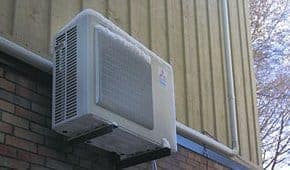
A Ductless Split consists of a wall-mounted unit in your home. It’s usually mounted near the ceiling on the second floor. You also have an outdoor condenser, which can be mounted on the exterior of the building or on the ground outside. Refrigerant lines connect the two units together.
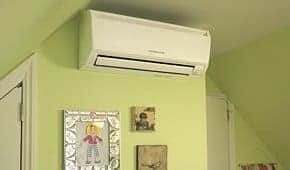
As the name implies, no ducting is required. In most homes, central air conditioning uses the furnace fan and duct system to distribute cool air. This type of system works well for heating, but is not ideal for cooling. Hot air registers are normally in the floor, because hot air rises. In the summer, cool air also has to be delivered from the floor, which is not ideal, because cool air falls.

In a two-storey home with central air, it is always difficult to keep the upper floor cool. A Ductless Split solves this problem, because the cool air is delivered at the ceiling level.

Buildings that use hot water heating through radiators or in-floor heating have no ductwork to use for central air. This is another ideal application for a Ductless Split.

Ductless Splits vs. Window Air Conditioners

Ductless Splits have many advantages over window air conditioners. They don’t block off part of your window. They don’t pose any security risk. They are quieter than a window unit. Finally, they don’t have to be stored away for the winter.

Heat Pumps

A Ductless Split can also be ordered as a heat pump, where the unit can both heat and cool. It works like an air conditioner on a warm day. The pump extracts heat from inside the home and transfer it outdoors. Conversely, on cold days the pump will flow heat energy into the home from the outside.

Unlike water, which has a boiling point of 100°C, the liquid refrigerant in a heat pump has a much lower boiling point, even lower than the cold outdoor air. This is why in heating mode, the refrigerant can still evaporate in the outdoor coil at low temperatures and draw heat from surrounding air, making the seemingly impossible heating with cold air possible. The now-heated gas refrigerant flows into the indoor coil and extracts the heat into the indoor air. Despite frigid temperatures the air will contain enough energy to heat the home, even at -30°C.

Heat Pumps are an ideal solution for a cottage. They can also compliment an existing wood, oil, propane or electric furnace. Heat Pumps are far more energy efficient than any of these heat sources and will lower your heating bills in the winter.

Multi-Head Units

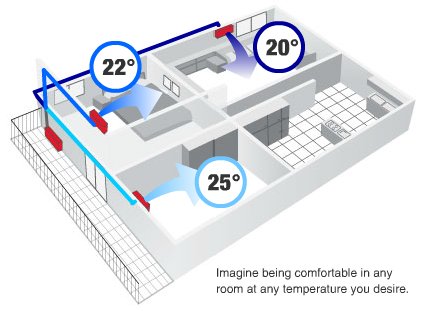
It is also possible to put wall-mounted units in several rooms. They all share the same outdoor condenser. This makes is possible to have different temperatures in different rooms. You can turn off the heating or cooling in a guest room if nobody is visiting, or you can keep an exercise room at a cooler temperature.
Mitsubishi Electric

The Hayter Group is a dealer for industry leading products from Mitsubishi Electric. We service and install Mr. Slim Heat Pumps and Ductless Air Conditioning. We also offer the Zuba Central system, which replaces traditional means of heating and cooling with one quiet, compact, highly efficient, ducted system that can save space and reduce annual energy costs.

Chad Hayter

Friday, 6 June 2014

Is Geothermal a Viable Option for Anybody?

I often hear from people that geothermal heating and cooling is not a practical choice for many people. Reasons cited are cost of installation and the misunderstanding that a large rural lot is required.


Geothermal Explained:


Geothermal is a combination of two words. Geo means ‘of the earth’ and thermal is to ‘heat’. The earth is a giant insulator. The ground temperature as little as five feet down remains almost constant all year round.

The heat store under the ground can be transferred to a building through a series of pipes called loops. The underground or underwater loops remove the heat from the ground and pump it into the building.

For cooling, the system is reversed. Heat is extracted from the building and pumped back to the earth.


Is Geothermal Difficult to Install?


The short answer is no. Depending on the space available, the installation of geothermal loops can be done in several different ways.

A vertical loop requires a deeper excavation than a horizontal loop, but it does not require a large rural lot. Loops can also run into a nearby pond or lake. Toronto has 130 buildings that draw their cooling energy from Lake Ontario.

Vertical installations are completed with powerful machines that drill down into the earth to find the warm spot, usually 100 - 200 feet down. Horizontal loops require excavation of long trenches.

What about the Cost?


On average, a geothermal system will cost 2 to 2.5 times the cost of an equivalent quality conventional heating and cooling system.

The geothermal system handles both heating and cooling. The system can also provide a good part of your hot water needs.

Homeowners that are building new or renovating will typically see 12 – 21% ROI on the premium paid for the geothermal system. The payback for a geothermal system can be as little as 3.5 years.

It’s not just for new construction. Older homes are not as well insulated and are not sealed off like a new home. A geothermal system can cut utility bills by up to 70%.


Fluctuating Energy Costs


The costs of oil, hydro, propane and natural gas have fluctuated in recent years. We all know about oil and hydro prices. Propane has recently become very expensive and low natural gas prices will not last forever.

Geothermal costs have remained stable since 2006 and are lower than $875 annually for most homes.

Geothermal delivers more bang for your buck. You get more heat per kilowatt of electricity used to run a geothermal system than any other fuel. You also produce additional energy, which can be used to heat hot water or warm swimming pools.

 
Home Resale Value

If you have two homes that are equal, except for their utility system. One house with a traditional gas furnace and hot water tank has a resale value of $300,000 in the current market. The one with geothermal should be worth 18 per cent more, with a resale value of $350,000.

The reason for the significant difference in value is twofold. First, geothermal systems are more energy-efficient. Second, replacement value is a factor with geothermal systems. They typically outlast conventional heating systems. The ground loop, which is a large part of the system’s cost, never needs to be replaced.


What is the Track Record for Geothermal?


Geothermal was first used to heat Canadian homes in the 1940’s. Since then, there have been many improvements in technology. Geothermal is now widely used in both businesses and homes. A number of well-known buildings such as Rideau Hall in Ottawa, the Pan-Am Aquatic structure in Toronto and The Forks Market in Winnipeg use geothermal. Even Buckingham Palace has a geothermal heating system.

Geothermal is a proven, reliable and green solution to your home comfort needs. For more information on geothermal heating and cooling, please visit our website.

Chad Hayter

Tuesday, 20 May 2014

Does it Pay to use a Programmable Thermostat?


Most people are familiar with thermostats that can be programmed to adjust the temperature of your home at night when you are asleep, or during the day when you are at work. In the heating season, you can program down the temperature when you are asleep or away from home. In the summer time, you can program the temperature higher when you are away.

Many homes still have simple thermostats that people adjust manually. Many other homes have programmable thermostats that the home owner does not know how to use. Most of these are set at the same temperature level all day long.

People often do not believe there is any savings from adjusting the thermostat for a few hours. They believe that it takes more energy to heat up the house when they get home (or cool down the house in the summer). According to this theory, it’s better to just maintain the home at a constant temperature.

In 2005, the Canadian Centre for Housing Technology did a study to find out if there were any savings using programmable thermostats. This Federal Government department has a research facility in Ottawa with two identical homes built in 1998. The homes are typical of many subdivision houses. They have two floors, with a two car garage and basement. They are built to the R-2000 standard, typical in most newer homes in Canada, with natural gas furnaces.

In one of the homes, for the winter test, the thermostat was set back to 18°C (64.4°F) from 11:00PM until 6:00AM. The temperature was also set back from 9:00AM to 4:00PM. The morning and evening normal temperature was set at 22°C (71.6°F).

The second home was set at a constant 22°C (71.6°F). The home with the programmable thermostat used 10% less gas and 1.9% less hydro. The hydro savings result from the furnace fan not running as much.

For the summer test, the home with the programmable thermostat had the temperature set higher to 25°C (77°F) from 9:00AM to 4:00PM every day. This produced a hydro saving of 10.7%.

This study dispelled the myth and made it quite clear that a programmable thermostat can pay for itself very quickly.

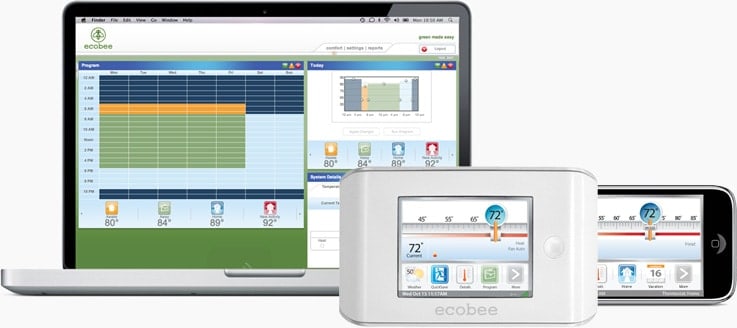
Today’s WiFi thermostats offer home owners even more reasons to upgrade. They are far easier to program than the earlier generation of thermostats. You can adjust your thermostat using your smart phone.

If you are away on vacation and forgot to turn down the heat, you can do it remotely. They also offer peace of mind. You can set them up to notify you if your furnace stops working when you are away.
The Hayter Group features WiFi thermostats by Ecobee and Honeywell. Furnaces, air conditioners, heat pumps and humidifiers can all be controlled by a modern thermostat. It’s more important than ever to have a professional installation to insure that your equipment is compatible with your thermostat.

You can enjoy a new thermostat controlled from your smart phone. If you are not currently automatically setting your thermostat when you are away, the new stat will pay for itself.


The Hayter Group

Wednesday, 12 March 2014

What are VOC’s? What is IAQ?

You’ve probably come across the acronym VOC if you’ve purchased paint lately. Volatile organic compounds (VOC’s) are a group of chemicals that contain carbon and hydrogen.

VOC’s are a very important factor in IAQ (Indoor Air Quality). VOC’s leak into your home’s air from a variety of sources including:
  • cigarette smoke
  • air fresheners
  • particle board in furniture and cabinets
  • paint and varnishes
  • glue
  • gasoline and other fuels
  • household cleaning products
  • carpets and under pads
  • foam cushions and mattresses
Many of these sources are commonly found in all homes. Indoor Air Quality is also impacted by biological pollutants like mould, bacteria and dust mites.

Health Canada estimates that Canadians spend 90% of their time indoors. This includes home, work and recreational facilities. Obviously, the largest portion of this time is spent in your own home.

Newer homes can actually present more problems than older homes. Newer homes are built to be as air tight as possible for energy efficiency. New homes are more comfortable and less drafty year round. Newer homes also contain more VOC’s, coming from new furniture, fresh paints, new carpets, etc. These pollutants stay trapped within the home.

Indoor Air Quality has a major influence on your health. Exposure to indoor pollutants can result in eye and skin irritation, nose and throat discomfort, headaches, nausea and fatigue. The EPA (Environmental Protection Agency) in the United States uses the name Sick Building Syndrome to describe illness caused by poor Indoor Air Quality.

There are several steps homeowners can take to improve IAQ:
  • Do not allow smoking in your home
  • Make sure kitchens and bathrooms are properly ventilated
  • Control humidity levels, make sure your home does not have areas that are always damp
  • Maintain appliances such as furnaces, gas stoves, water heaters
  • Check your furnace filters regularly
  • Install CO (Carbon Monoxide) Detectors
  • Use low VOC paints and cleaners
  • In Newer homes, consider installing an HRV (Heat Recovery Ventilator) or an ERV (Energy Recover Ventilator)
  • Consider an Air Purifier mounted in your heating ducts

Air Purification Equipment

New technology originally developed by the Space Program has been adopted by an American company called Air Oasis. They manufacture a device which mounts into your ducting system. After installation, you can be breathing cleaner air within an hour. 99% of allergens, viruses and mold are removed from the air. Within an hour, 85% of VOC’s are also removed from your home’s air.


HRV’s & ERV’s

A Heat Recovery Ventilator (HRV) keeps your home supplied with a steady flow of fresh outdoor air. As stale, warm air is expelled, the heat recovery core warms the incoming fresh, colder air before it is distributed within your home. This constant supply of fresh air eliminates drafts and provides increased home comfort. By providing proper ventilation, an HRV controls excess humidity in your home. Improved ventilation will also improve indoor air quality.

Energy Recovery Ventilators (ERV) are suited to climates with hot humid summers, like we have in Southern Ontario. Similar to an HRV, the ERV recovers the heat in cold season, however, it also captures the energy trapped in moisture, which greatly improves the overall recovery efficiency. The ERV works as follows: In air conditioned homes, when it is more humid outside than inside, the ERV limits the amount of moisture coming into your home. In winter, when the humidity level is reversed, the ERV limits the amount of moisture expelled from your home.


Tuesday, 25 February 2014

Propane, Now an Expensive Way to Heat Your Home

There is now a propane crisis in rural Ontario that has become so serious that the Federal Government has called for an investigation.

Propane has been in short supply this year and selling at premium prices. Customers without fixed price contracts have been paying $1.18 per litre this January 2014, up from $.70 per litre in the Fall of 2013.

If you are using propane, approximately 65% of it is being used for heating your home. 22% goes for hot water and about 13% for cooking. These numbers will vary with the size and age of your home. The size of your family may also change these numbers.

As recently as five years ago, Propane was amongst the most economical ways to heat. Equipment costs were also very reasonable, because propane furnaces are almost identical to natural gas furnaces, which are manufactured in large numbers. As a result, many rural properties in Ontario rely on propane.

Propane has now passed both Electric and Oil and is now the most expensive way to heat your home or business.

The answer to this growing problem is right in the ground on your property. A geothermal system can reduce your bills for heating, cooling and hot water by up to 70%. With a geothermal heat pump, you are protected by swings in market prices for commodities like propane, oil or natural gas.

The additional costs of installing geothermal are easily justified by the long-term savings. Many property owners will see savings that are large enough, so that the system will pay for itself. There are several financing options available, so that you can start enjoying the benefits of a geothermal system today.

Chad Hayter

The Hayter Group